I’m home sick today, listening to the BBC News Hour on WBEZ. There’s been a lot about the Archbishop of Canterbury’s recent comments regarding sharia law in Britain.
Here’s part of what he actually said, which was in a BBC News interview before a lecture before legal academics, where he went into more detail:
In an BBC interview before the lecture, Dr Williams said: “Certain provisions of sharia are already recognised in our society and under our law; so it’s not as if we’re bringing in an alien and rival system. . . There is a place for finding what would be a constructive accommodation with some aspects of Muslim law, as we already do with some kinds of aspects of other religious law.†He made it clear that there was no question of adopting the extreme punishments or treatment of women found in some Islamic states.
The lecture is quite densely argued and is quoted extensively at the Church Times article, along with reactions from a number of people who clearly did not agree that sharia law could possibly be as nuanced and enlightened-sounding as laid out in Archbishop Rowan’s address. Here’s an excerpt:
DR WILLIAMS began by criticising sensational reporting of sharia cases. “What most people think they know of sharia is that it is repressive towards women and wedded to archaic and brutal punishments.†He quoted the Muslim scholar Tariq Ramadan: “Many Muslim intellectuals do not dare even to refer to the concept for fear of frightening people or arousing suspicion of all their work by the merest mention of the word.â€
But the matter of accommodating religious moral codes was important, not only because it spilled over “into some of the questions which have surfaced sharply in the last 12 months about the right of religious believers in general to opt out of certain legal provisions, as in the problems around Roman Catholic adoption agencies which emerged in relation to the Sexual Orientation Regulations last spring.â€
He argued for a better understanding of sharia. “On the one hand, sharia depends for its legitimacy not on any human decision, not on votes or preferences, but on the conviction that it represents the mind of God; on the other, it is to some extent unfinished business so far as codified and precise provisions are concerned. “To recognise sharia is to recognise a method of jurisprudence governed by revealed texts rather than a single system.â€
Islamic societies in general recognised a degree of religious pluralism, with the result that “the Muslim, even in a predominantly Muslim state, has something of a dual identity, as citizen and as believer within the community of the faithful.†Though this would be “hotly contested by some committed Islamic primitivists . ….the great body of serious jurists in the Islamic world would recognise this degree of political plurality as consistent with Muslim integrity.â€
Although Cartoon Dave is more or less ignoring the controversy, he finds some interesting links, and in the comments was a link to this gem:
Rowan Williams, being a very intelligent man, knows that sharia law is far more complex than this. The vast bulk of Islamic laws that are invoked within Muslim communities (yes, present tense because it is a current reality here in Britain), concern family relationships (divorce and separation), and inheritance matters. The trouble is, the media and our beloved political establishment are either not intelligent enough to know this or, and God forbid this be the case, prefer to play to the simplistic public perception (sharia = stonings etc) for short term electoral expediency.
The ABC has been accused of being “muddle-headed and unhelpful.” I’d say it’s the press (especially the sort that has large type, small pages, and headlines like “WHAT A BURKHA” ) that’s got it wrong and making it worse. Now an unnamed and courageously anonymous Senior Church of England Official is calling for +++Rowan’s resignation. Now that’s muddle-headed and unhelpful in a Lambeth year, unless you’ve got your own ambitions tucked up your purple sleeve.
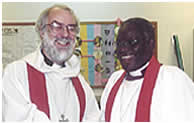
The Global South guys in Africa, who complain that Islam is their biggest rival for souls and spiritual turf, are probably getting ready to make an announcement. Frankly, I expect that Archbishop Akinola will call for the ABC to step down openly (and loudly). This is a break for him; he can criticize as much as he likes without fear of backlash. It plays into his hands, since he’s all set to run his GAFCON meeting… which +++Rowan, being a smart guy, must have anticipated this. So why say it now anyway? Would it benefit him if the arch-conservatives all cancelled their Lambeth plans and left in a huff to start their own Anglican Covenant Union? It would make collegial suppers after the sessions so much easier to plan, with not having to consider who won’t sit with whom.
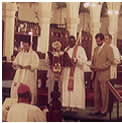
For now, the official website of the Church of Nigeria shows both primates together in a photo… and farther down on the page, you can see that the Presiding Bishop of the Episcopal Church is shown, too. Strange that ++Frank Griswold is still in office in Nigeria, 4 years after he turned things over in the US to ++Katharine.
UPDATE
The pictures of both Archbishop Rowan and Presiding Bishop (retired) Frank are now gone from the Church of Nigeria website, which has been updated overnight.
[tags]Archbishop of Canterbury, sharia, controversy, Akinola[/tags]

